
Getting Started
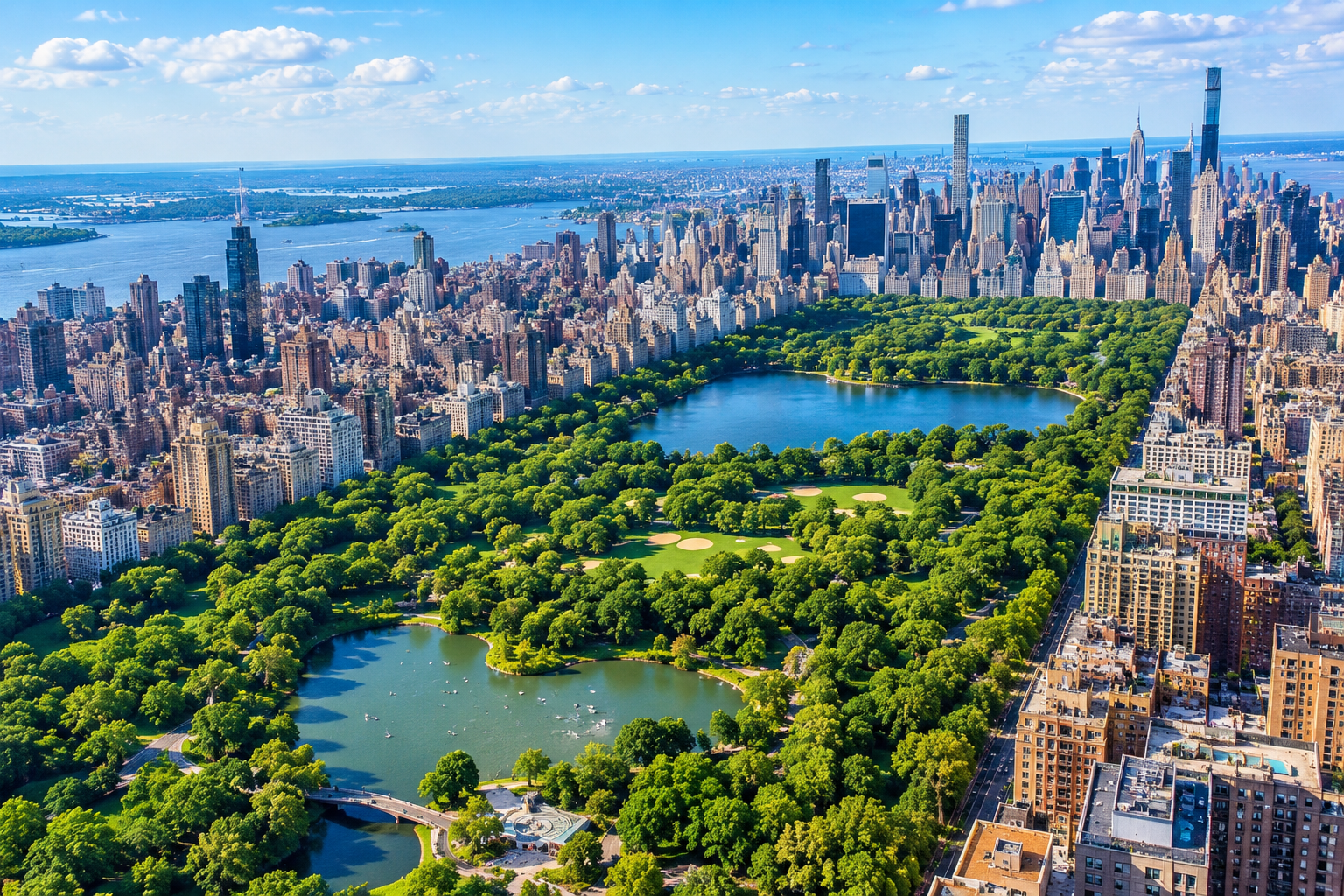
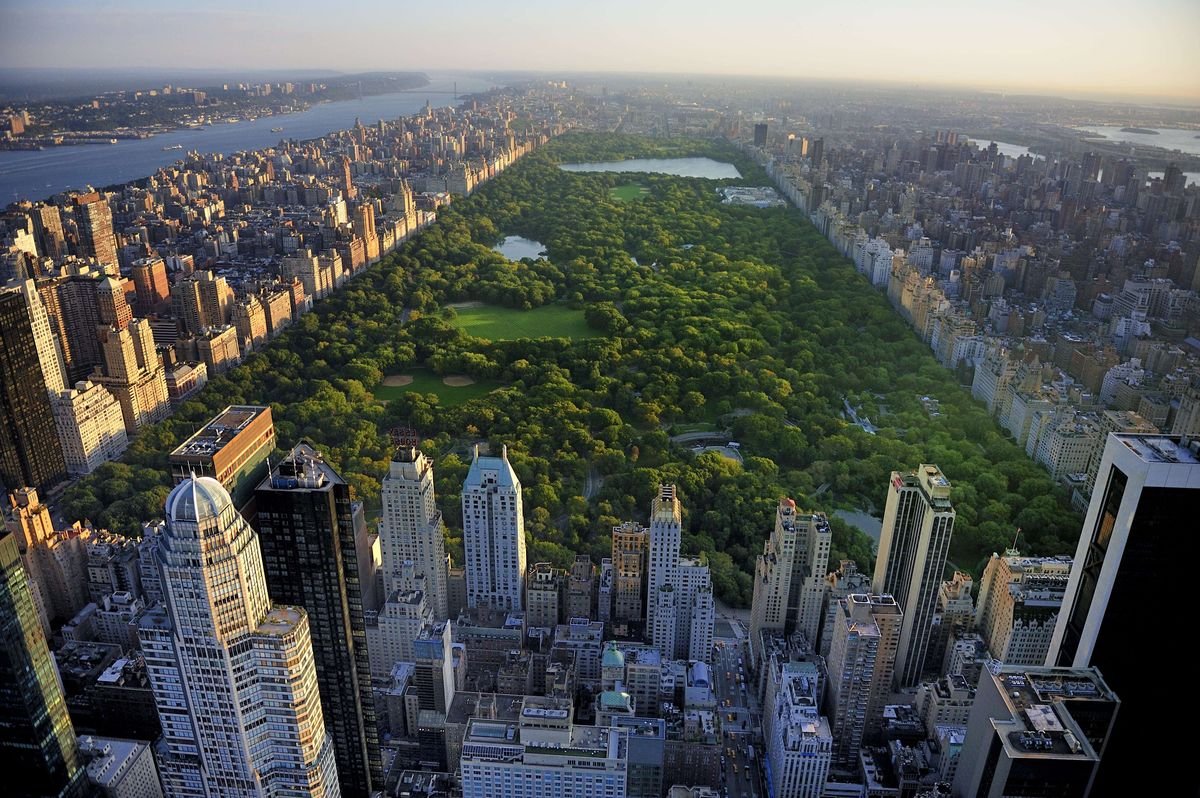
Central Park is not simply a large green space dropped into the middle of Manhattan; it is a carefully designed landscape where formal terraces, wooded paths, open lawns, bridges, water, gardens, and city views unfold across 843 acres.
Central Park can feel surprisingly different from one block to the next. At the southern end, skyscrapers and Fifth Avenue frame the Park, while a short walk can bring you beneath the American elms of The Mall, onto the steps of Bethesda Terrace, or beside the water at The Lake.
That is where visiting Central Park for the first time becomes especially useful. A first visit can go smoothly until a map shows several attractions scattered across a landscape that is much bigger than it appears on a Manhattan street grid.
For a classic first visit, the area around The Mall, Bethesda Terrace, Bow Bridge, and the Lake creates a particularly efficient sightseeing sequence. These landmarks sit close enough to connect on foot, yet each offers a different side of Central Park.
Time of day deserves the same attention as the route. Reaching Bethesda Terrace around 8–9 a.m. gives an earlier start before the day becomes busier, while a late-afternoon visit around 4–6 p.m. can work well for travelers who want softer light around the Lake and Bow Bridge.
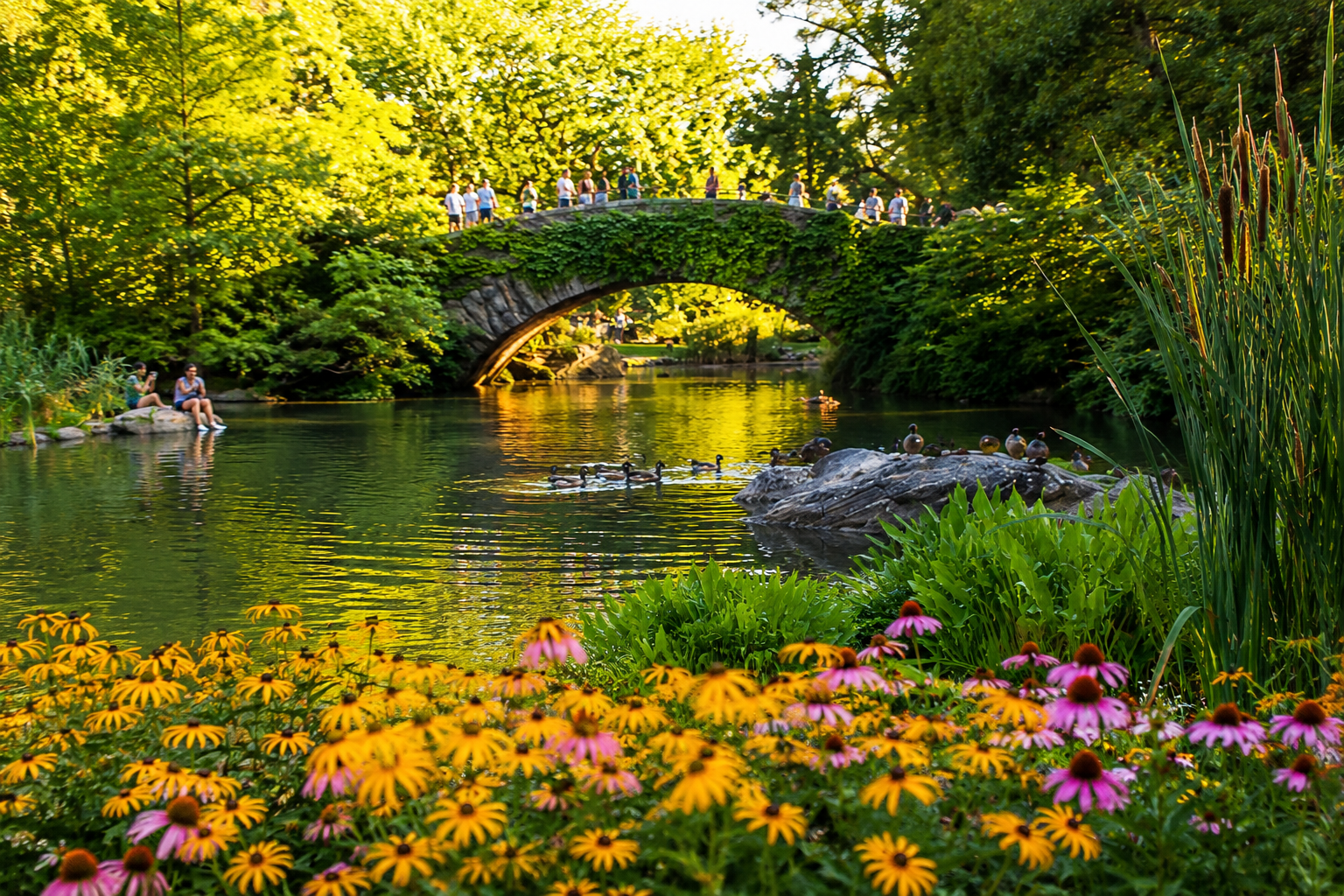
The Park also doubles as a giant outdoor movie set. Gapstow Bridge, for example, is near the southeast corner around East 62nd Street, while Bethesda Terrace, The Mall, Bow Bridge, and other recognizable locations have appeared in films and television productions.
The sections ahead bring together Central Park’s Attractions, Activities, and Visitor Tips without asking you to treat the Park like a checklist.
You will also find links to deeper guides when a particular subject deserves more attention, including the Best Time to Visit Central Park to Avoid Crowds and Movie and TV Filming Locations You Can Visit in Central Park.
The aim is simple: help you decide where to enter, which places belong together, how much time to allow, and when to move on—before Central Park’s size turns a pleasant walk into an unnecessarily long one.
Why Central Park Deserves a Spot on Every New York Itinerary
Central Park changes the pace of a New York trip. Within its 843 acres, the scenery shifts from the formal beauty of The Mall and Bethesda Terrace to the wooded trails of The Ramble, the open views around the Reservoir, and the water landscapes of The Lake.
Families might combine Heckscher Playground near West 59th–62nd Streets with nearby southern Park attractions, while couples can connect Bethesda Terrace, Bow Bridge, and The Lake into one scenic walk. The best family attractions in Central Park and guides to Central Park attractions for couples can take those plans further.
Central Park for solo travelers has more freedom to choose their pace. The 1.58-mile Reservoir Loop offers a clearly defined walk with skyline views, whereas The Ramble between West 73rd and 79th Streets is better for travelers who enjoy winding paths and a more natural setting.
Walking across Bow Bridge, strolling along The Mall, relaxing on Sheep Meadow, and exploring public landscapes such as Conservatory Garden are among the most affordable things to do in Central Park, as they can be enjoyed without any admission fee.
Photography rewards travelers who choose the location before choosing the hour. Around 6:00–7:00 a.m. in summer or 7:00–8:00 a.m. in winter, the Reservoir can provide earlier light and a quieter atmosphere; around 4:00–6:00 p.m., depending on the season, the Lake and Bow Bridge can offer warmer late-day light. The best times of day to photograph Central Park guide provides more location-specific photography planning.
Nature lovers should look beyond the famous southern landmarks. The Ramble offers 36 acres of woodland, Hallett Nature Sanctuary sits beside the Pond near East 60th–62nd Streets, and the six-acre Conservatory Garden occupies the area between East 104th and 106th Streets.
Together, they show why the best gardens and nature spots in Central Park are worth planning as destinations in their own right.
Quick Snapshot:
Who Will Enjoy Central Park Most?
| Best For | A Strong Starting Point | Why It Works |
| ✔ Families | Heckscher Playground and the southern Park | Easy way to combine play and sightseeing |
| ✔ Couples | The Lake, Bow Bridge, or Conservatory Garden | Water, bridges, gardens, and quieter scenery |
| ✔ Solo Travelers | The Reservoir or The Ramble | Choose between an easy loop and woodland exploration |
| ✔ Budget Travelers | Walking routes, lawns, bridges, and gardens | Plenty of experiences do not require an attraction ticket |
| ✔ Photographers | Reservoir, Lake, Oak Bridge, and Hallett Nature Sanctuary | Skyline, water, woodland, and changing light |
| ✔ Nature Lovers | The Ramble, Hallett Nature Sanctuary, and Conservatory Garden | Woodlands, wildlife habitat, and formal plantings |
One practical point ties all of these experiences together: Central Park is best treated as a collection of connected landscapes, not one attraction. Pick the experience that matters most to you, build a route around it and enjoy.
Before You Visit Central Park
The Central Park Conservancy provides the most useful current information for locations, facilities, maps, and park conditions, while the National Park Service offers valuable historical context about the landscape designed by Frederick Law Olmsted and Calvert Vaux.
A good Central Park visit starts before you reach the first entrance. The Park is open from 6:00 a.m. to 1:00 a.m. year-round..
A little planning also changes how the Park feels. Instead of arriving with a long list of landmarks, decide first whether your day is about seasonal scenery, photography, a short walk, a longer exploration, or simply finding one of the peaceful places to visit in Central Park away from the busiest routes.
The five decisions below can help you build that plan without turning a park visit into a rigid schedule.
Best Time of Year to Visit
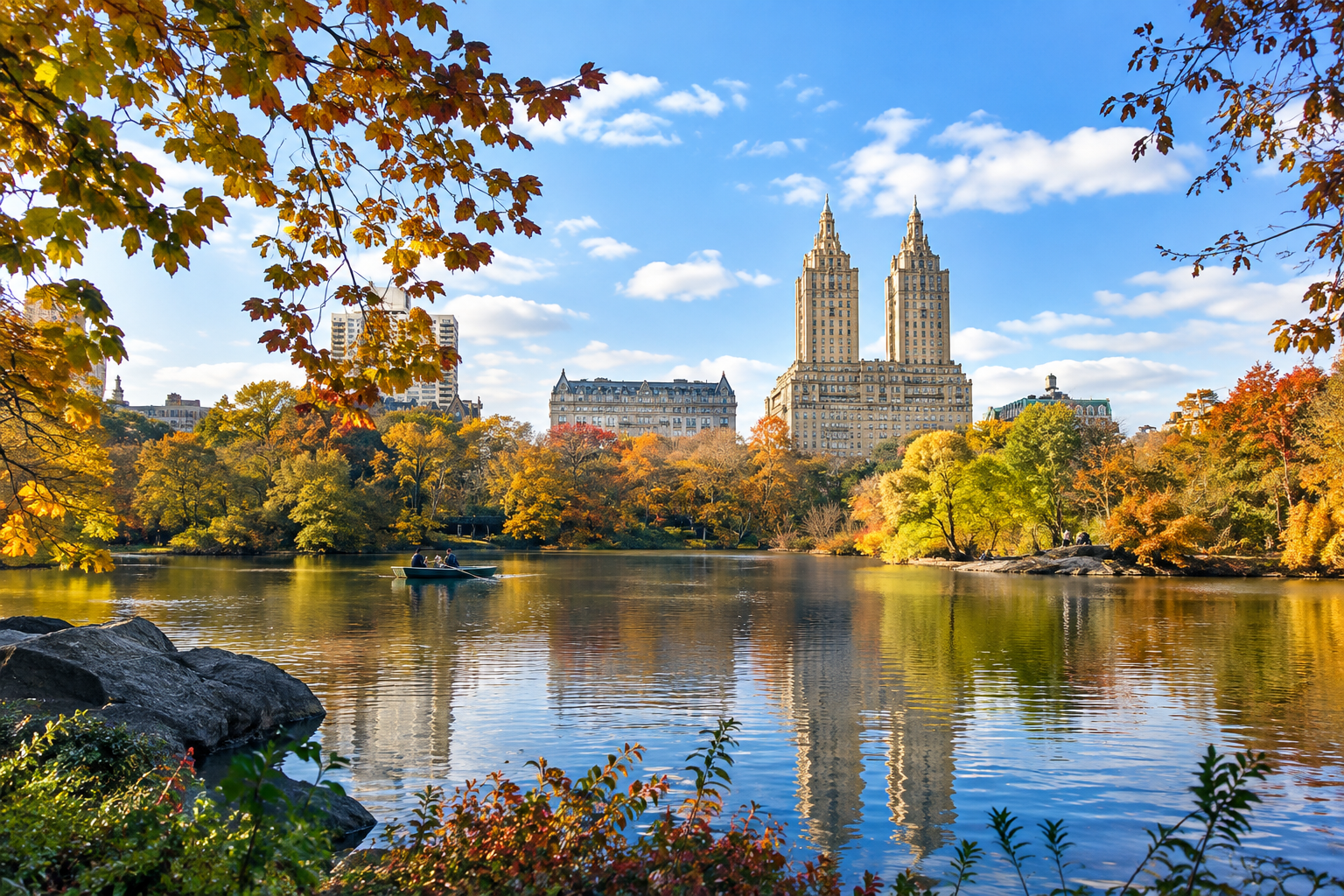
The calendar changes Central Park more than a simple weather forecast suggests. Spring brings flowering trees and formal garden displays, summer gives the Park long daylight hours and fuller greenery, autumn changes the color of the woodland and avenues, while winter exposes views and landscape shapes that can be harder to notice beneath dense foliage.
For a first visit centered on scenery, April through May can be especially rewarding because the Park’s gardens and flowering landscapes become major attractions in their own right.
Autumn has a different advantage. The changing leaves can make woodland areas such as The Ramble and the North Woods feel dramatically different from the more formal landscapes farther south.
Winter is worth considering for a quieter landscape and clearer views through bare branches. For a detailed month-by-month look at foliage, seasonal scenery, and activities, see our Central Park Through the Seasons: Views, Activities, and Events guide.
Best Time of Day to Visit
An early start gives you more daylight for a longer route and can be useful for travelers who want photographs.
Late afternoon serves a different purpose. Light moves across the lawns, bridges, water, and buildings, giving places such as The Lake and Bow Bridge a different photographic quality from the same locations at midday.
If photography is part of your plan, our best times of day to photograph Central Park guide goes deeper into choosing the right hour for specific landscapes rather than treating the entire Park as one photography location.
How Much Time Should You Plan?
Start with the places you care about, not with a number of hours. Central Park is large enough that a short visit can become frustrating if the route includes distant locations on opposite sides of the Park.
Your available time should also determine how ambitious the itinerary becomes. The best way to visit Central Park with limited time (1 or 2 hours), prioritize one defined area rather than trying to reach the Reservoir, Conservatory Garden, The Ramble, and southern landmarks in the same visit. With several hours available, you can build a route that combines major sights with a quieter landscape instead of spending the entire visit moving from one destination to another.
For a clearer breakdown of 1 hour, 2–3 hours, half-day, and full-day plans, see our How much time do you have to visit Central Park? guide.
What to Pack
There is no need to fill your bag with items you will carry all day without using. A lighter daypack with water, a phone or camera, weather protection, and the essentials for your particular route is usually more practical than packing for every possible situation.
A Central Park day rarely requires specialized equipment, but the wrong small choices can become annoying after several hours of walking. Comfortable walking shoes should come first, followed by a reusable water bottle, weather-appropriate clothing, and anything you need for the season.
For a detailed seasonal checklist, including footwear, clothing, photography gear, and family needs, see our What to Pack for a Day in Central Park guide.
Common Mistakes First-Time Visitors Make
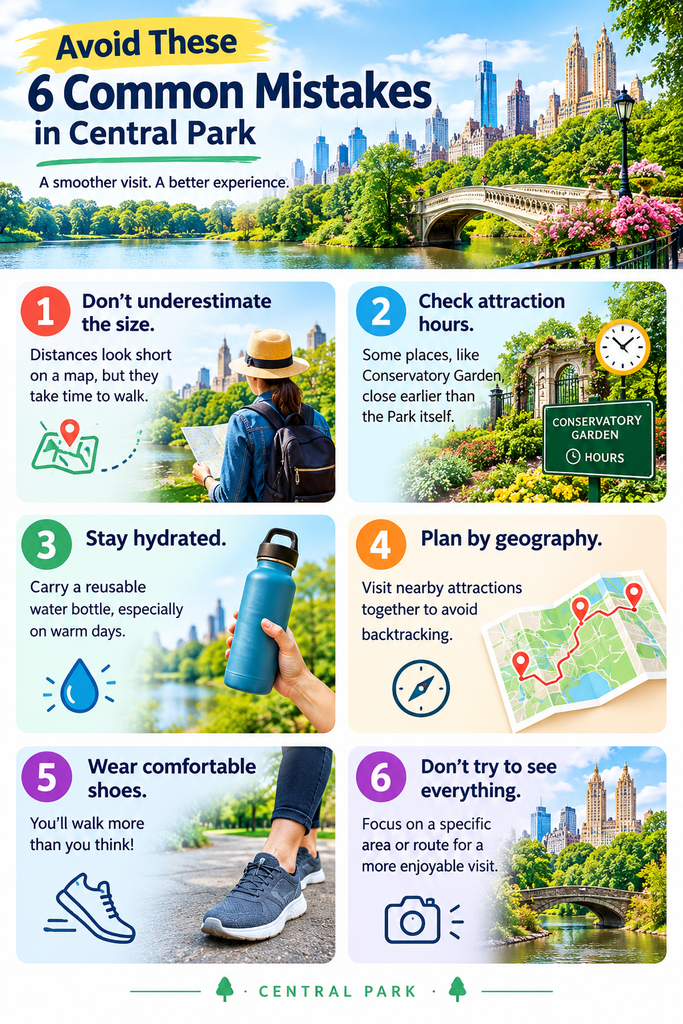
➤ Do not underestimate the size of Central Park. Distances that look short on a map can require significant walking time.
➤ Check attraction hours before visiting. Some destinations inside the Park, such as Conservatory Garden, operate on schedules different from the Park itself.
➤ Carry a reusable water bottle. Staying hydrated is especially important during long walks in warm weather.
➤ Plan routes by geography. Visiting nearby attractions together reduces unnecessary backtracking across the Park.
➤ Know restroom locations in advance. Facilities are spread throughout the Park, and operating hours vary by location.
➤ Wear comfortable walking shoes. Many visitors underestimate how much walking a typical Central Park visit involves.
➤ Do not try to see everything in one trip. Focusing on a specific area or route often creates a more enjoyable experience.
➤ Download a map before arriving. Cell service can be inconsistent in some areas, and an offline map helps with navigation.
➤ Allow extra time for photo stops. Scenic locations such as Bow Bridge, Bethesda Terrace, and The Mall often take longer to explore than expected.
➤ Check the weather forecast. Conditions can influence which routes, activities, and open spaces are most comfortable to enjoy.
➤ Start early if visiting during peak seasons. Popular areas become busier later in the day, especially on weekends and holidays.
➤ Bring sun protection in warmer months. Open lawns and pathways can offer limited shade during midday hours.
➤ Do not rely solely on food vendors. If meals are part of your plan, identify nearby cafés, restaurants, or picnic spots beforehand.
➤ Pay attention to seasonal conditions. Some gardens, viewpoints, and landscapes look dramatically different throughout the year.
➤ Leave room for spontaneous discoveries. Some of Central Park’s most memorable bridges, paths, gardens, and viewpoints are found while exploring beyond a fixed itinerary.
These are among the mistakes tourists make in Central Park that are easy to prevent with a few minutes of planning. Our Mistakes Tourists Make in Central Park (And How to Avoid Them) guide covers the practical problems in greater detail, including route planning, timing, navigation, and preparation.
Central Park at a Glance
If you are deciding where to spend your time, these eight locations give you a quick starting point. Each offers a different side of Central Park, from formal architecture and bridges to open lawns, water, gardens, and cultural landmarks. Use the cards below to choose your priorities before moving into the detailed attraction guide.
The Mall
Why visit: The Mall is one of Central Park’s most recognizable formal landscapes, lined with American elms and leading toward Bethesda Terrace. It is especially appealing for architecture, photography, and a classic Central Park walk.
Time needed: 15–30 minutes for a focused walk and photographs.
Best for: First-time visitors, photographers, architecture lovers, and couples.
Bow Bridge
Why visit: Bow Bridge crosses The Lake and creates one of the Park’s most scenic viewpoints, with water, trees, and surrounding hillsides forming the backdrop. Its compact size makes it easy to include during a longer route through Central Park.
Time needed: 15–25 minutes for the bridge, viewpoints, and photographs.
Best for: Photography, couples, scenic walks, and first-time visitors.
Bethesda Terrace
Why visit: Bethesda Terrace brings together architecture, sculpture, steps, and views toward The Lake in one concentrated area. It is one of the strongest choices when you want several recognizable Central Park features without covering a large distance.
Time needed: 20–40 minutes depending on how much time you spend around the terrace, arcade, and fountain.
Best for: First-time visitors, architecture, photography, history, and couples.
The Lake
Why visit: The Lake offers a more open waterside setting than the Park’s formal terraces, with changing views toward Bow Bridge, Bethesda Terrace, and the surrounding landscape. A walk beside the water works well when you want scenery without making a landmark the entire focus of the stop.
Time needed: 30–60 minutes for a relaxed section of the shoreline and nearby viewpoints.
Best for: Scenic walks, photography, couples, and nature lovers.
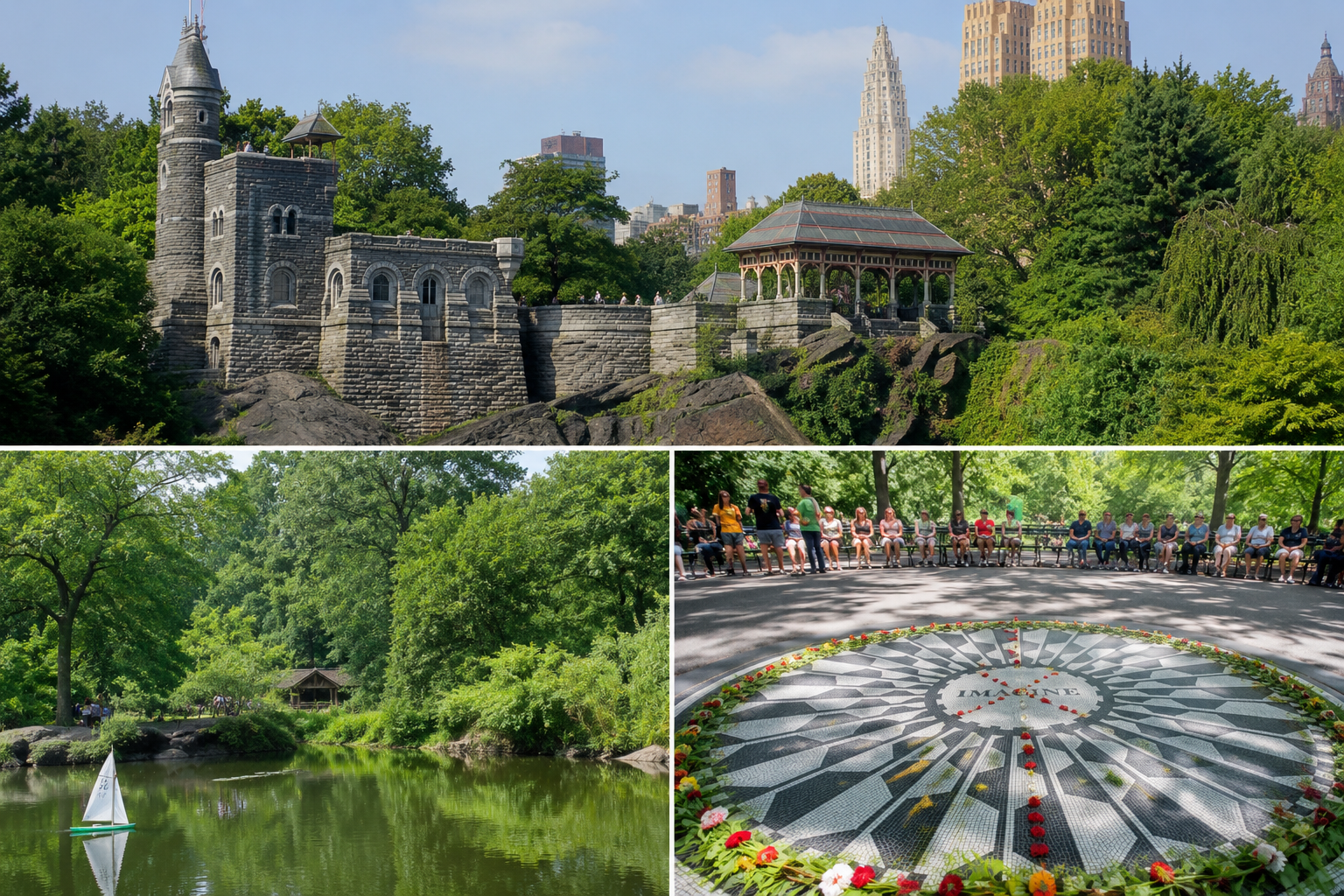
Belvedere Castle
Why visit: Belvedere Castle sits above the surrounding landscape and provides a different perspective from the Park’s lower paths. Its elevated position makes it particularly useful for travelers who want architecture combined with broader Central Park views.
Time needed: 20–30 minutes for the castle area and surrounding viewpoints.
Best for: First-time visitors, photographers, families, architecture lovers, and panoramic views.
Great Lawn
Why visit: The Great Lawn is a large open landscape in the center of the Park, surrounded by mature trees and prominent Upper East and Upper West Side buildings. It is less about checking off a monument and more about seeing Central Park’s enormous open-space design.
Time needed: 20–40 minutes for a short visit or longer if you want to relax on the lawn.
Best for: Families, picnics, relaxing, open views, and recreation.
Strawberry Fields
Why visit: Strawberry Fields is the Central Park memorial dedicated to John Lennon, located near Central Park West and West 72nd Street. Its intimate scale makes it a natural stop for visitors interested in music history and the cultural side of New York City.
Time needed: 15–25 minutes for the memorial and surrounding area.
Best for: Music fans, history, cultural sightseeing, and first-time visitors.
Conservatory Garden
Why visit: Conservatory Garden offers a completely different atmosphere, with six acres divided into French, Italianate, and English-style sections. Its formal planting, fountains, sculptures, and seasonal displays make it one of the Park’s strongest choices for garden-focused sightseeing.
Time needed: 30–60 minutes for a comfortable visit through the three garden sections.
Best for: Garden lovers, photographers, couples, families, and travelers seeking a quieter landscape.
Must-See Attractions in Central Park
Central Park has dozens of landmarks and landscapes, but eight stand out for a first substantial visit. The National Park Service recognizes the Park as an Olmsted-designed landscape that deliberately combines formal spaces, natural scenery, and architectural features, while NYC Parks manages the city’s park system and its public facilities. The ranking below is based less on fame alone and more on what each place adds to a Central Park itinerary.
Card #1: Bethesda Terrace
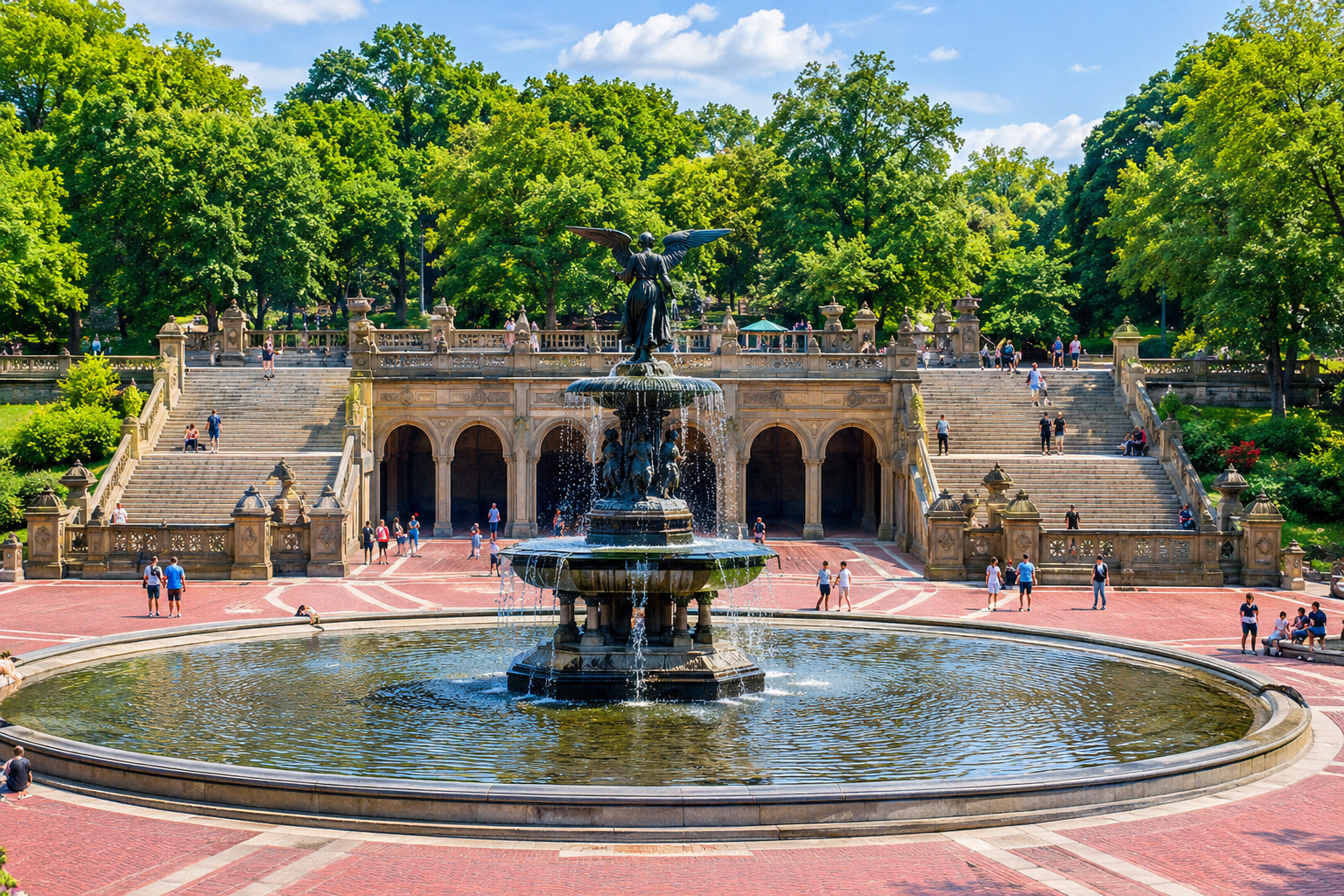
Bethesda Terrace is the strongest starting point for seeing how Central Park combines architecture with landscape. Located at mid-Park around 72nd Street, it brings together the grand staircase, the two-level terrace, the Arcade, and Bethesda Fountain beside The Lake.
There is also an important 2026 update: Bethesda Fountain is currently turned off for a comprehensive restoration that began in August 2026 and is expected to last approximately one year. Bethesda Terrace itself remains open, so the terrace, Arcade, stairs, and surrounding views can still be included in your itinerary.
If you are deciding on the best time to visit Bethesda fountain, remember that the fountain is presently under restoration; for the surrounding terrace, earlier hours can provide a calmer setting, while later daylight can work better for photographs.
For deeper planning, pair this stop with your Complete Guide to Bow Bridge in Central Park.
Priority: ★★★★★
Allow: 30–45 minutes for the Terrace, Arcade, stairs, and surrounding views.
Best for: First-time visitors, architecture, history, photography, and couples.
Card #2: Bow Bridge
Bow Bridge is worth prioritizing because the bridge and its setting were designed to work together. At mid-Park around 74th Street, the cast-iron bridge crosses The Lake and connects the Ramble with paths leading toward Bethesda Terrace and Cherry Hill.
Bow Bridge in Central Park works so well in a route. Among the popular bridges in Central Park, Bow Bridge is unusual because it crosses a water body; the Conservancy notes that it is the only one of the Park’s original cast-iron bridges designed to cross water rather than the bridle path.
Priority: ★★★★★
Allow: 20–30 minutes for the bridge, photographs, and nearby viewpoints.
Best for: Photography, couples, scenic walks, and first-time visitors.
Card #3: Belvedere Castle
Sitting atop Vista Rock at mid-Park around 79th Street, Belvedere Castle rises above Turtle Pond and provides views toward the Great Lawn, The Ramble, and the surrounding city.
The structure was completed in 1872 and its name comes from the Italian word belvedere, meaning “beautiful view,” which neatly describes why the location remains worth the climb.
For travelers interested in Belvedere Castle Central Park views, timing is more restrictive than it is at most open landscapes. The castle is open daily from 10:00 a.m. to 5:00 p.m., with terrace access ending at 4:55 p.m.; it is closed on Thanksgiving Day, Christmas Day, and New Year’s Day.
Priority: ★★★★★
Allow: 30–45 minutes for the castle and viewpoints.
Best for: Panoramic views, photography, architecture, history, and families.
Card #4: Strawberry Fields
The five-acre Strawberry Fields occupies the West Side between West 71st and 74th Streets, near the West 72nd Street entrance, and centers on the Imagine mosaic honoring John Lennon.
The surrounding landscape matters here as much as the mosaic. Curved paths, trees, shrubs, and open planting areas create a setting intended for reflection and photography.
If you are visiting Strawberry Fields in Central Park, allow enough time to look beyond the mosaic and notice the landscape around it.
Priority: ★★★★☆
Allow: 20–30 minutes for the memorial and surrounding landscape.
Best for: Music history, cultural sightseeing, peaceful stops, and first-time visitors.
Card #5: Conservatory Garden
Located between East 104th and 106th Streets, the six-acre Conservatory Garden is divided into French, Italianate, and English sections, each with its own layout and planting style.
The Center Garden features a formal Italianate design and fountain, the North Garden is known for seasonal tulips and the Untermyer Fountain, and the South Garden follows an English perennial-garden style.
It opens daily at 8:00 a.m., with closing times ranging from 5:00 p.m. in January and February to 8:00 p.m. from May through August 14; the September, October, and late-August hours also change with the season.
If flowers, formal landscaping, and quieter scenery are priorities, Conservatory Garden in Central Park is worth the trip to the Park’s northern end. Your Central Park’s Gardens and Nature Beauty guide can also provide the deeper garden-focused planning details.
Priority: ★★★★☆
Allow: 45–60 minutes for all three garden sections.
Best for: Garden lovers, photographers, couples, families, and seasonal scenery.
Card #6: Great Lawn
The Great Lawn earns its place because it shows Central Park as public open space rather than as a collection of monuments. The 55-acre lawn occupies the Park’s geographical center between approximately 79th and 85th Streets, surrounded by mature trees, sports fields, and views toward the Upper East and Upper West Side skylines.
If you are visiting The Great Lawn in Central Park, think of it as a place to slow down rather than simply photograph. Picnicking, relaxing, people-watching, and walking among the surrounding trees give the area a different purpose from landmarks such as Bethesda Terrace or Bow Bridge.
Priority: ★★★★☆
Allow: 30–45 minutes for sightseeing and relaxing; allow longer for a picnic or recreation.
Best for: Families, picnics, relaxing, open views, and landscape history.
Card #7: The Mall
The Mall is the straightest and most formal pedestrian landscape in Central Park. Located mid-Park around East 66th–71st Streets, its two rows of American elm trees create a long canopy leading north toward Bethesda Terrace.
The southern portion is Literary Walk, named for the statues of writers placed along the promenade. William Shakespeare, Robert Burns, Sir Walter Scott, and other literary figures appear along this stretch, while the Women’s Rights Pioneers Monument was added in 2020.
The best time to visit The Mall, Central Park depends on the experience you want. Earlier in the day, the elm canopy can provide a calmer setting for photographs and a slower walk; later, the changing light along the long perspective can create a very different view.
For a more detailed walk through the promenade and its literary monuments, see The Mall and Literary Walk visitor guide.
Priority: ★★★★☆
Allow: 20–30 minutes for the Mall and Literary Walk; allow longer when combining it with Bethesda Terrace.
Best for: Photography, literature, architecture, history, and first-time visitors.
Card #8: Sheep Meadow
Sheep Meadow is one of the most relaxed attractions on this list. This 15-acre lawn occupies the West Side between 66th and 69th Streets. As a designated Quiet Zone, it is best suited for a peaceful picnic, reading break, or relaxation stop rather than a loud gathering.
The name is not symbolic. Sheep actually grazed here from 1864 until 1934, when the Park moved away from maintaining the meadow as a working sheep pasture. Today the lawn is used for relaxing, reading, sunbathing, and picnicking.
For a Sheep Meadow visitor guide in Central Park, plan your visit around the operating schedule. Sheep Meadow opens daily at 11:00 a.m. and closes during the winter months to allow the grass to recover.
Priority: ★★★★☆
Allow: 30–60 minutes for relaxing, photography, or a picnic.
Best for: Picnics, families, relaxing, skyline views, and open-space scenery.
Central Park Routes for Different Time Budgets
A common mistake is trying to see every major landmark in a single visit. Central Park covers 843 acres, and walking inefficiently can consume more time than the attractions themselves. The routes below are designed to help you see the right places for the time you actually have rather than chasing a long checklist.
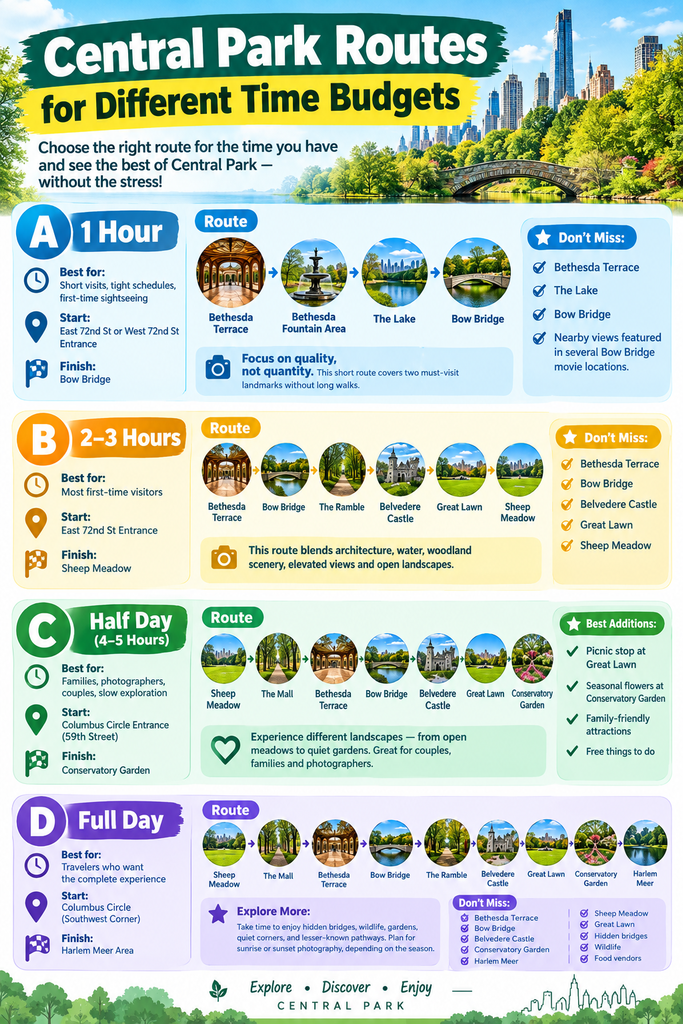
Route A: 1 Hour
Best for: Short visits, tight schedules, first-time sightseeing
Start: East 72nd Street or West 72nd Street Entrance
Finish: Bow Bridge
Route:
Bethesda Terrace → Bethesda Fountain Area → The Lake → Bow Bridge
If this is your first visit, focus on quality rather than quantity. This route covers two of the must visit landmarks in Central Park without requiring long walks across the Park.
The route begins at Bethesda Terrace, one of the best landmarks to see in Central Park and a centerpiece of countless photographs, films, and travel guides. From there, walk toward The Lake and continue to Bow Bridge, one of The Most Famous Bridges in Central Park.
The short distance between these locations makes this route ideal for a central park first time visitor guide approach because almost every minute is spent sightseeing rather than navigating.
Don’t miss:
✔ Bethesda Terrace
✔ The Lake
✔ Bow Bridge
✔ Nearby views featured in several Bow Bridge movie locations
Route B: 2–3 Hours
Best for: Most first-time visitors
Start: East 72nd Street Entrance
Finish: Sheep Meadow
Route:
Bethesda Terrace → Bow Bridge → The Ramble → Belvedere Castle → Great Lawn → Sheep Meadow
This is the route that fits most travelers best. It combines architecture, water, woodland scenery, elevated views, and open landscapes without requiring a full-day commitment.
Along the way, you’ll pass several of the must see places in central park for first time visitors and gain a strong understanding of how the Park changes from one landscape to another.
Photography enthusiasts will also encounter some of the best photography spots in Central Park, including Bow Bridge, Belvedere Castle, and the Great Lawn skyline views.
Don’t miss:
✔ Bethesda Terrace
✔ Bow Bridge
✔ Belvedere Castle
✔ Great Lawn
✔ Sheep Meadow
Route C: Half Day (4–5 Hours)
Best for: Families, photographers, couples, slow exploration
Start: Columbus Circle Entrance (59th Street)
Finish: Conservatory Garden
Route:
Sheep Meadow → The Mall → Bethesda Terrace → Bow Bridge → Belvedere Castle → Great Lawn → Conservatory Garden
A half-day visit allows you to experience Central Park as a sequence of different landscapes rather than a collection of isolated landmarks.
Begin in Sheep Meadow before crowds build, then continue through The Mall’s elm-lined promenade toward Bethesda Terrace. The transition from formal pathways to lakeside scenery around Bow Bridge is one of the Park’s most enjoyable walks.
This route works particularly well for Romantic Things to Do in Central Park for Couples, families following a Central Park with Kids: Complete Planning Guide, and photographers searching for the best places to take pictures in Central Park.
Conservatory Garden provides a quieter ending than the busier southern sections of the Park.
Best additions:
✔ Picnic stop at Great Lawn
✔ Seasonal flowers at Conservatory Garden
✔ Some of the family-friendly attractions in Central Park New York
✔ Several free things to do in Central Park
Route D: Full Day
Best for: Travelers who want the complete experience
Start: Columbus Circle (Southwest Corner)
Finish: Harlem Meer Area
Route:
Sheep Meadow → The Mall → Bethesda Terrace → Bow Bridge → The Ramble → Belvedere Castle → Great Lawn → Conservatory Garden → Harlem Meer
A full day gives you enough time to slow down and notice details that shorter visits often miss.
This route naturally combines highlights from a Central Park full day itinerary, the Central Park Map Guide: Where to Go First, and Three Iconic Central Park Stops Every First-Time Visitor Should See.
Along the way, look for hidden bridges in Central Park, observe seasonal wildlife in Central Park, and stop at Central Park Food Vendors: Locations, Food Options, and Tips when you need a break. Food carts around Bethesda Terrace, the Great Lawn area, and major crossroads often provide quick options without leaving the Park.
Photographers can also plan around Central Park sunrise photography or Central Park sunset photography depending on the season and available daylight.
Don’t miss:
✔ Bethesda Terrace
✔ Bow Bridge
✔ Belvedere Castle
✔ Conservatory Garden
✔ Harlem Meer
✔ Sheep Meadow
✔ Great Lawn
Which Route Should You Choose?
If you only have one visit planned, Route B offers the best balance of scenery, landmarks, and walking distance. Route C is usually the sweet spot for travelers wanting a genuine Central Park half day itinerary without feeling rushed. Route D delivers the broadest experience and allows time for gardens, wildlife, quieter landscapes, food stops, and some of the least crowded areas of Central Park.
Before starting any route, review your Central Park packing list for visitors, carry the essential items for a Central Park visit, and follow basic guidance from your Central Park Travel Safety Guide. Avoid common Central Park visitor mistakes such as underestimating walking distances, entering from the wrong side of the Park, or trying to fit every attraction into a single afternoon.
Choose Your Perfect Central Park Experience
Not every Central Park itinerary should look the same. A family with young children, a couple planning a relaxed afternoon, and a photographer chasing golden-hour light will naturally prioritize different parts of the Park.
Instead of following a one-size-fits-all route, start with the experience that matches your travel style and build your day around it.
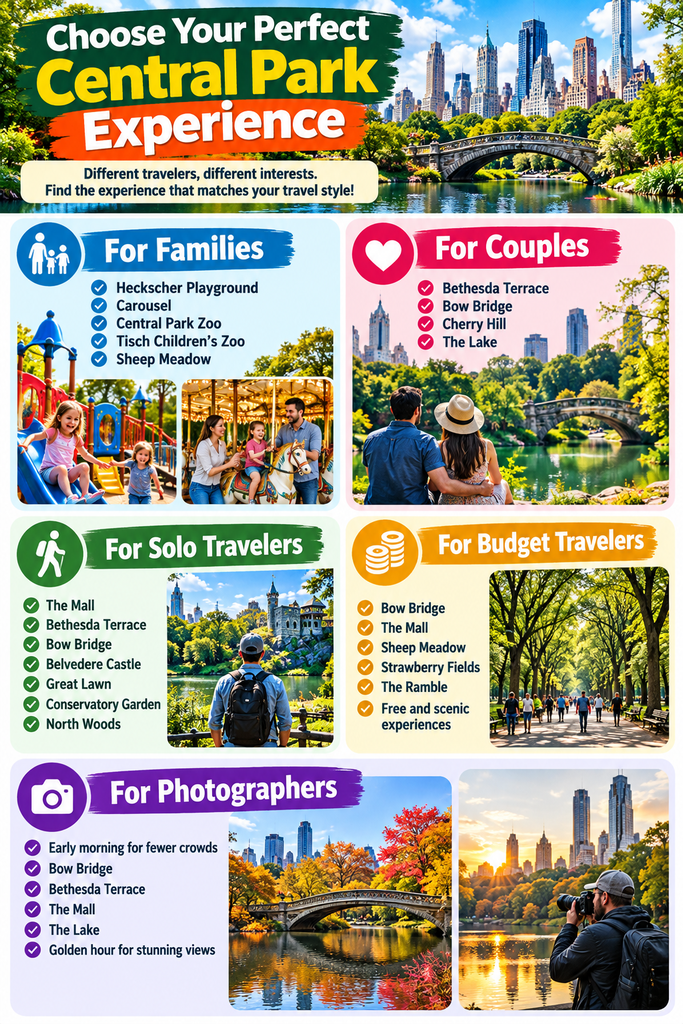
For Families: The laughter coming from Heckscher Playground near Central Park South often signals one of the Park’s most popular family areas. With climbing structures, water features, and open play spaces, it gives children a chance to burn energy before exploring other attractions.
A practical family route starts at Heckscher Playground near Central Park South, continues to the Carousel, then loops through the Central Park Zoo and Tisch Children’s Zoo before heading toward Sheep Meadow. The attractions sit close enough together to reduce long walks while still giving children several completely different experiences during the day.
For more enjoyment and better planning, explore Central Park with Kids: Complete Planning Guide and Best Playgrounds in Central Park for Kids for practical ideas and a more organized visit to Central Park.
For Couples: Rather than trying to cover the entire Park, couples often enjoy choosing a smaller section and slowing down. A route connecting Bethesda Terrace, Bow Bridge, Cherry Hill, and The Lake allows time to appreciate the scenery instead of constantly checking a map.
The gentle movement of the water beneath the bridge creates a quieter atmosphere than the busy streets only a short walk away.
For additional route ideas and better planning, read our Romantic Things to Do in Central Park for Couples guide.
For Solo Travelers: For a first solo visit, staying on well-traveled routes around The Mall, Bethesda Terrace, Bow Bridge, Belvedere Castle, and the Great Lawn is often the simplest approach.
Conservatory Garden near East 105th Street and the wooded trails around the North Woods usually feel calmer than the heavily visited southern attractions. These locations remain active throughout much of the day and are easy to connect using major pathways.
For more route suggestions and planning advice, continue with the Solo Traveler’s Guide to Central Park.
For Budget Travelers: One of Central Park’s biggest advantages is that some of its best experiences cost nothing. Walking across Bow Bridge, exploring The Mall, relaxing in Sheep Meadow, visiting Strawberry Fields, and wandering through the Ramble are all free.
Travelers trying to keep costs low do not need to sacrifice scenery. Several of the Park’s most recognizable landmarks can be seen during a single day without purchasing tickets or joining a tour.
Looking for more ways to enjoy the Park without spending money? Explore our guide to the best free activities in Central Park NYC for simple and budget-friendly ideas.
For Photographers: Early morning often works best for photographers seeking cleaner compositions around Bow Bridge, Bethesda Terrace, and The Mall. Fewer people on the paths can make framing architecture and landscapes significantly easier.
Late-day light creates another opportunity. Warm sunlight filtering through tree canopies near The Mall and reflections across The Lake can produce some of the most memorable images of the day.
For location-specific guidance, explore Central Park Photo Spots for Visitors to find the best places for capturing memorable views throughout the Park.
Exploring Central Park’s Lakes, Gardens, and Natural Areas
Central Park is often remembered for its bridges, terraces, and famous landmarks, but some of its most rewarding experiences are found in the landscapes between them. Water, woodland trails, formal gardens, and secluded shorelines reveal a quieter and more natural side of Central Park.
The Lake
The Lake sits at the heart of Central Park’s most scenic landscape. Stretching across the mid-Park area near Bethesda Terrace, Bow Bridge, and Cherry Hill, it creates a natural transition between formal architecture and wooded scenery.
A walk along the shoreline reveals changing perspectives of Bow Bridge, while the paths near Cherry Hill open broader views across the water toward the wooded edges of the Ramble.
Few locations combine rowboats, Bow Bridge, Bethesda Terrace, Cherry Hill, and woodland views within the same landscape. For that reason, Central Park’s most beautiful lakes and ponds discussions frequently begin with The Lake.
The Pond
Tucked inside the Park’s southeastern corner near Fifth Avenue and 59th Street, The Pond feels surprisingly secluded considering its location beside some of Manhattan’s busiest streets. Dense plantings, rocky outcrops, and winding shorelines help create the impression of a much larger natural area than its actual size.
Photographers often arrive here shortly after sunrise. Because The Pond sits just inside the southeast corner near Grand Army Plaza, it can be explored even during a short visit before continuing toward Midtown attractions.
Conservatory Water
Conservatory Water offers a completely different atmosphere from The Lake or The Pond. Located near East 74th Street, this formal water feature is best known for its model sailboats and the broad open space surrounding the shoreline.
Families often combine Conservatory Water with the Alice in Wonderland statue, located only a short walk away, before continuing west toward the Swedish Cottage Marionette Theatre. Those exploring family-friendly attractions in Central Park New York often include all three stops in the same outing.
Harlem Meer
At the northeastern corner of Central Park, Harlem Meer feels noticeably different from the landscapes surrounding Bethesda Terrace and The Mall. The water body sits beside the North Woods and the Dana Discovery Center, creating a setting that feels more natural and less formal than the Park’s southern attractions.
A visit to Harlem Meer works especially well during a longer itinerary. The quieter atmosphere, tree-lined shoreline, and occasional ripples moving across the water create a very different mood from the heavily photographed southern landmarks.
Conservatory Garden
Conservatory Garden demonstrates how dramatically Central Park can change from one landscape to another. Located between East 104th and 106th Streets, the six-acre garden replaces winding woodland paths with formal layouts, fountains, seasonal flower displays, and carefully maintained plantings.
The garden is divided into three distinct sections. The North Garden features the Untermyer Fountain and seasonal tulip displays, the Center Garden follows an Italianate design with a formal lawn and pergola, and the South Garden reflects the style of an English perennial garden.
The Ramble
The Ramble is one of the easiest places in Central Park to feel temporarily disconnected from Manhattan. Covering roughly thirty-six acres between The Lake and Belvedere Castle, it was intentionally designed with winding paths, uneven terrain, rocky outcrops, and dense vegetation.
Birdwatchers often consider the Ramble one of the Park’s most important ecological areas. More than two hundred bird species have been recorded in Central Park over the years that attract enthusiasts hoping to spot species resting within the woodland habitat.
The Lake, The Pond, Conservatory Water, Harlem Meer, Conservatory Garden, and the Ramble each offer a distinct atmosphere despite existing within the same 843-acre landscape. For a deeper look at these areas, continue with Central Park’s Most Beautiful Lakes and Ponds, where each location is explored in greater detail.
Central Park Quick Planning Summary
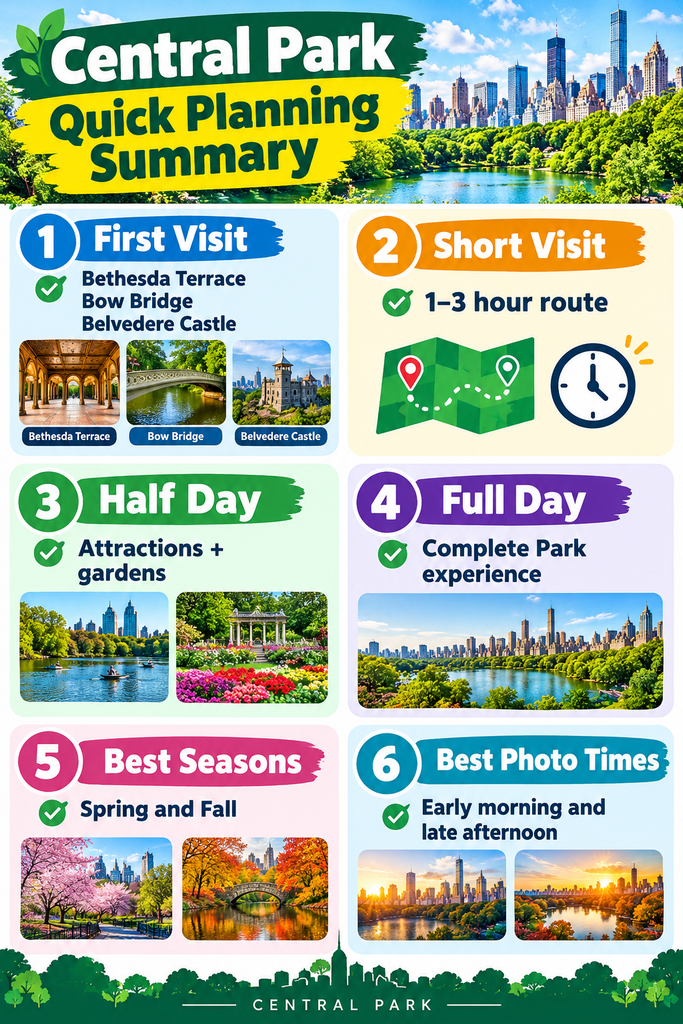
✔ First visit: Bethesda Terrace, Bow Bridge, Belvedere Castle
✔ Short visit: 1–3 hour route
✔ Half day: Attractions + gardens
✔ Full day: Complete Park experience
✔ Best seasons: Spring and Fall
✔ Best photo times: Early morning and late afternoon
Final Insights
Few places in New York allow someone to stand beside Bethesda Terrace, walk through the woodland trails of the Ramble, and later reach the formal flower displays of Conservatory Garden without leaving the same park.
That variety is one of the reasons Central Park remains one of the city’s most enduring attractions. Historic landmarks, lakeside scenery, gardens, wildlife habitats, and recreational spaces all exist within the same 843-acre landscape.
Families, photographers, nature lovers, and first-time visitors often leave with completely different memories because Central Park offers far more than a single sightseeing route.
Families can focus on some of the top things to do in Central Park with family, photographers can build a route around changing light and viewpoints, and budget-conscious travelers can enjoy numerous cheap activities in Central Park NYC without sacrificing the experience.
A stop beside The Lake, a walk through The Mall, or a quick meal from nearby Central Park food carts can easily become one of the most memorable moments of the day.
Visiting Central Park: Attractions, Activities, and Visitor Tips is ultimately about finding the places, landscapes, and experiences that match your style of travel and allowing enough time to enjoy them at your own pace.


One Response